
Calls for Deeper US Military Role Divide Nigerians Amid Rising Terror Attacks
Debate intensifies over US military involvement in Nigeria’s anti-terror war as activists, analysts and regional groups express sharply divided views.
Nigeria’s counter-terrorism strategy has entered a new phase of national debate.
Following reports of US military intelligence support and a Christmas Day strike targeting terrorist enclaves in Sokoto, divergent voices across the country are now weighing in on whether America should deepen its operational role in Nigeria’s fight against insurgency.
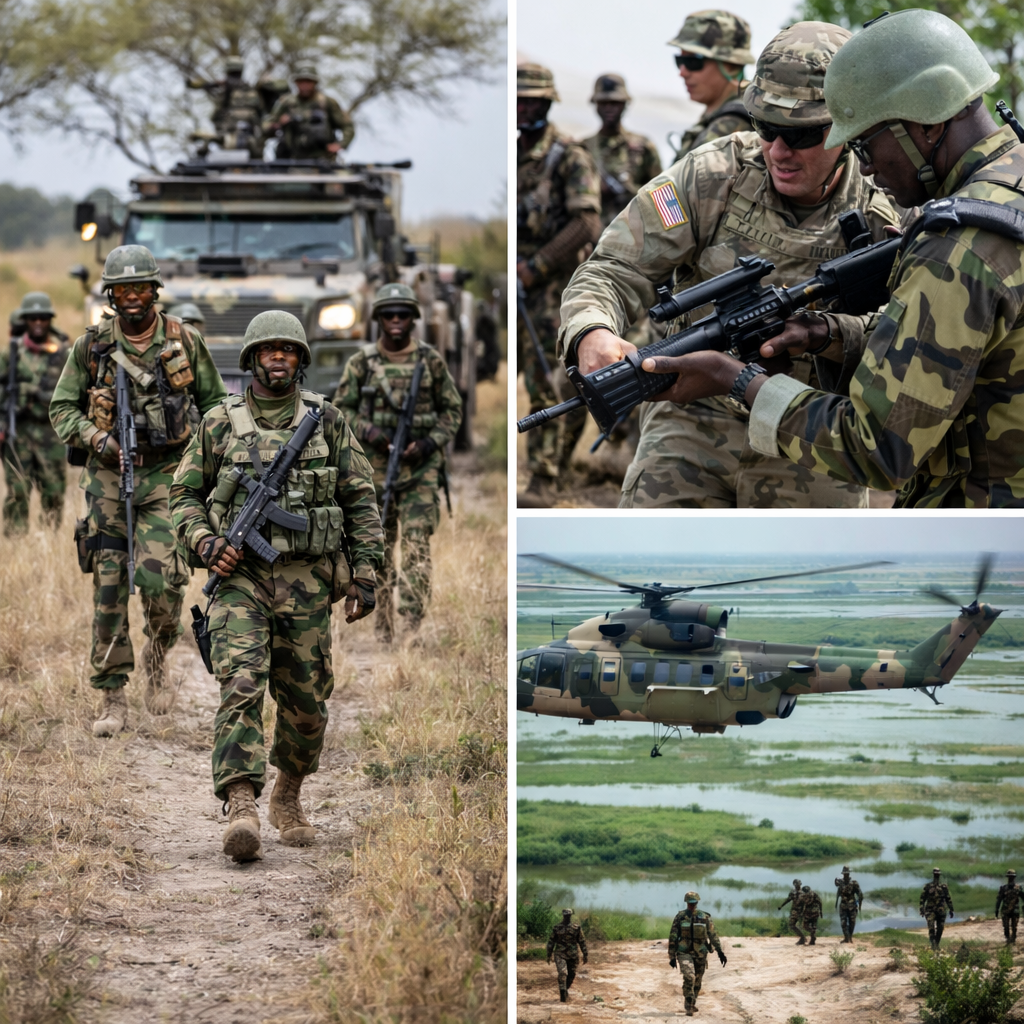
The reported presence of US military personnel on Nigerian soil — primarily for intelligence sharing and training — has triggered intense public discourse. While some activists and security commentators argue that stronger intervention, including direct strikes, could weaken terror networks, others caution against expanding foreign combat roles.
Security consultant Nasiru Braimah welcomed foreign assistance, arguing that Nigeria requires enhanced tactical coordination, modern technology, and operational reforms. According to him, the challenge is not manpower but capacity gaps in advanced warfare systems and strategic incentives.
Similarly, civil society voices such as David West of the Civil Liberties Organisation (CLO) suggested that if insurgent violence continues unchecked, the US presence may need to extend beyond intelligence gathering — but only under coordinated collaboration with Nigerian authorities.
However, counter-arguments remain strong.
Retired military officers and analysts warn that direct foreign troop deployment raises constitutional, sovereignty, and geopolitical concerns. Major Rasaki Salawu noted that insurgency responses are rarely linear and that temporary escalations after military strikes do not automatically signal failure. He stressed that foreign assistance should strengthen, not replace, domestic security architecture.
The debate also reflects historical sensitivities. Groups such as the Arewa Defence League (ADL) have publicly opposed any expansion of US boots on Nigerian soil, arguing that deeper foreign military entrenchment could undermine sovereignty and create long-term instability, citing precedents in Afghanistan, Iraq, and Libya.
Meanwhile, the Northern Youth Council of Nigeria (NYCN) emphasised that terrorism in Nigeria is not purely a military problem. It linked insecurity to governance deficits, unemployment, poverty, and institutional weaknesses — factors that cannot be solved solely through foreign combat operations.
Former security chiefs and analysts further argue that Nigeria must clarify operational demarcations between military, police, and intelligence agencies to improve effectiveness. Structural reform, intelligence fusion, border security enhancement, and accountability mechanisms remain recurring recommendations.
The Core Question
At the centre of the debate lies a difficult balancing act:
- Should Nigeria invite deeper foreign combat involvement in the interest of immediate security gains?
- Or should it prioritise strengthening domestic capacity to preserve long-term sovereignty and institutional integrity?
While frustration over rising attacks fuels calls for stronger foreign strikes, concerns about dependency, accountability, and geopolitical entanglement remain equally powerful.
Nigeria’s fight against terrorism is at a crossroads. The choices made today — whether leaning toward expanded foreign military roles or doubling down on internal reform — will shape not just security outcomes, but the country’s sovereignty and strategic posture in years to come.
The debate is far from settled.
Stay informed with verified news and analysis — visit @peachymediatv.
Tags:
US military Nigeria, Terrorism in Nigeria, Nigerian Army, Counter terrorism debate, Arewa Defence League, Nigeria sovereignty, US intelligence support, Theresa Adeyemi Political Desk
By Theresa Adeyemi, Political Analyst and Media Strategist.